




Subscribe to our mailing list

July 30, 2026 | Donor Acquisition, Donor Data, Donor Engagement, Donor Retention, Donor Segmentation, Fundraising Communication, Major Donors
Putting Your Donor Data to Work:
6 Ways to Improve Donor Segmentation with AI and Fundraising Automation
If your donor segmentation begins and ends with building a list, your nonprofit is leaving much of its donor data unused—and potential revenue on the table.
Every gift, event registration, email response, volunteer shift, personal conversation, and program preference can tell you something about a supporter’s relationship with your mission.
But collecting that information in your donor management system is only the first step. Your team also needs to be able to interpret the data, identify the donors who need attention, tailor your communications, and follow through at the right time. That may sound like a lot of work—but with a connected fundraising CRM, it doesn’t have to be.
In The Donor Segmentation Checklist, we explain how to build a segmentation strategy that improves fundraising performance and grows nonprofit revenue. Here, we’ll go one step further: exploring how the AI tools and fundraising automation in your donor CRM can help you keep those groups current, tailor your outreach, and turn donor insights into timely action.
Why AI and automation matter for donor segmentation
Traditional donor segmentation often focuses on producing a static list of recipients for a fundraising campaign. This process probably sounds familiar: define the criteria (e.g., giving level, frequency, geographic location), export the list of names, send the communication, and repeat for the next campaign.
That approach has limits—and over time, it can be labor-intensive.
For one thing, lists become outdated as donor behavior changes. For another, lists alone can’t help you with the most important elements of effective donor segmentation: knowing which donors to prioritize, crafting the appropriate message for every audience, and taking the right action at the right moment.
A modern donor management system like DonorPerfect connects these steps. Built-in AI and fundraising automation can help fundraisers:
- Understand their donors by interpreting data, enriching records, and prioritizing opportunities
- Communicate more relevantly by keeping donor groups current and adapting messages
- Act more consistently by prompting staff members and scheduling timely outreach
Here are six ways fundraising AI and nonprofit automation can make the donor segmentation process more effective, efficient, and actionable.
See your donors more clearly
Beyond knowing which donors meet a basic set of criteria, your fundraising software should also help your team understand the full context behind each donor record and recognize which relationships warrant your time and attention.
1) Enrich donor data with actionable context
Giving history is an essential source of donor data, but it rarely tells the whole story. For instance, two people may have given similar amounts over the past several years while having very different interests, capacities, or relationships to your organization. If your segmentation strategy relies only on total giving, those differences may remain hidden.
Wealth screening tools like DonorSearch by EverTrue, which integrates with DonorPerfect, supplement the information in your fundraising CRM with valuable prospect intelligence. Insights can include charitable giving history, real estate and stock holdings, business affiliations, nonprofit involvement, and other indicators of a donor’s capacity and likelihood to give.
Your team can use that added context to:
- Identify potential major donors within your existing database
- Prioritize donors who are most likely to respond
- Distinguish between donors with similar giving histories
- Create targeted acquisition, retention, and upgrade strategies
- Prepare for more informed donor conversations
Data enrichment tools shouldn’t be used to replace what staff members know about a donor, but they can add context that helps them decide where a different approach may be appropriate.
BOTTOM LINE: Better donor segmentation relies on better donor data, not just more of it.
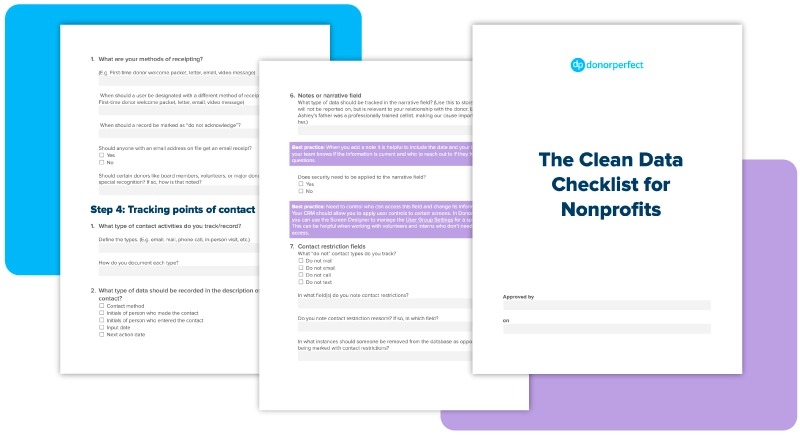
Build smarter segments with cleaner donor data
Use our free checklist to establish consistent data-entry practices, reduce errors, and prepare your records for more accurate reporting and donor segmentation.
2) Prioritize donors based on relative engagement
Even important donor segments can be too large to act on effectively.
Imagine you want to pull a list of all LBYUNT donors—those who gave last year but haven’t given this year—and your CRM identifies nearly 1,000 individuals who fit that criteria. Your team probably doesn’t have the capacity to personally contact every single donor on that list. Sending every person the same message may also overlook important differences in their giving and engagement.
Tools like DonorPerfect’s built-in Donor Score can automatically prioritize donors to help you focus your outreach efforts.
Donor Score assigns each donor a holistic score from 0 to 100 based on how recently, how often, and how much they give compared with the rest of your donor base. In DonorPerfect, the score appears on your Constituents Page and the donor’s profile, giving you a quick way to understand giving engagement and identify which records should get more attention.
Your team might combine Donor Score with your CRM’s reporting tools to:
- Find highly engaged donors within a larger campaign audience
- Discover potential upgrade opportunities
- Identify lapsed donors with stronger re-engagement potential
- Review recurring donors for deeper cultivation
- Quickly determine which donors you should prioritize
Giving-based scoring is a helpful starting point for segmentation, but it doesn’t paint a full picture on its own. Review donors’ assigned scores alongside outreach reports, campaign response, event participation, program interests, and your team’s personal relationship knowledge.
BOTTOM LINE: Effective donor segmentation helps fundraisers decide where to focus their time and resources.
Turn donor data into your next fundraising decision
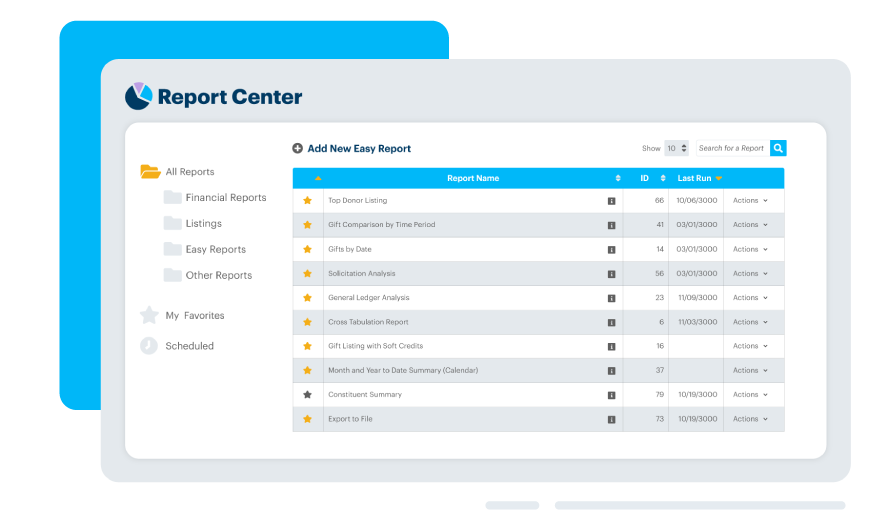
Use DonorPerfect reports, dashboards, and at-a-glance data insights to identify key segments, compare fundraising performance, and focus your team’s outreach efforts. You can even schedule key reports to be automatically emailed to stakeholders on a recurring basis, so everyone has the information they need when they need it.
Make outreach personal and relevant
The value of a donor segment depends on whether your data remains accurate and messaging remains relevant. AI and automation features can reduce the repetitive manual work required to keep both up to date.
3) Keep donor segments current with connected CRM data
Static spreadsheets and one-time exports start going out of date as soon as you create them. A first-time donor makes a second gift. A longtime supporter transitions from active to lapsed. An event attendee becomes a monthly donor. Someone moves, changes their email address, or updates their communication preferences.
If these changes are not reflected in your records and selection criteria, donors may remain in the wrong segment or receive an irrelevant message.
Instead of rebuilding lists manually for every campaign, use your fundraising CRM and integrated email marketing platform to create saved criteria, filters, and reusable reports for recurring audiences.
These could include:
- First-time donors within a defined period
- Monthly donors approaching a giving anniversary
- Event attendees who have not yet made a gift
- Donors who gave last year but not this year
- Supporters of a specific campaign who recently engaged
- Loyal donors with high prospect indicators
Be sure to define when donors enter or leave each group. How long does someone remain a “new donor”? When do you consider a donor lapsed? What activity should qualify a donor for deeper cultivation?
Maintaining the quality of the underlying data is equally important. DonorPerfect includes tools for quickly identifying and merging duplicate records while preserving gifts, pledges, contacts, and relevant contact information. DP Address Updater can compare donor information with National Change of Address data and automatically refresh records, helping teams maintain more current mailing information.
Integrations and online donation forms with automatic gift syncing can further reduce the lag between donor activity and the data available for segmentation. When gifts and engagement information return to the same donor management system, your team can build audiences from a more complete and current view of the relationship.
BOTTOM LINE: A segment should reflect the donor relationship now, not when you last exported the list.
Keep donor segments and email lists in sync
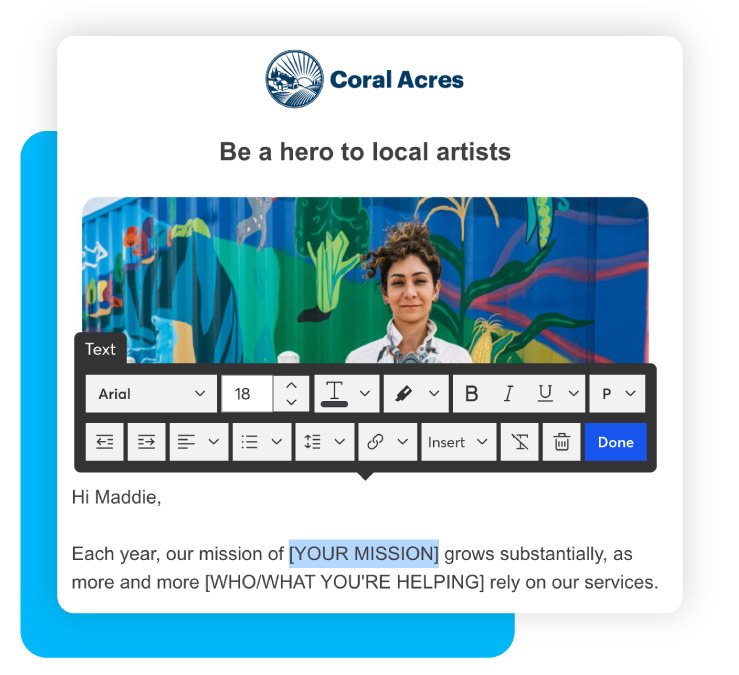
Every DonorPerfect plan comes with Constant Contact built in, making it easy to build mailing lists with your latest donor data, personalize and design compelling messages, and automatically bring engagement results back into your CRM.
4) Create targeted messaging with AI writing tools
Segmentation won’t improve the quality of your fundraising communications unless you adapt your messaging in a meaningful way. A first-time donor should not receive the same acknowledgment as a longtime monthly supporter. A lapsed donor should not be addressed as though they gave last week. A potential major donor may need thoughtful cultivation rather than receiving a general appeal.
This level of precision makes for much stronger outreach and stewardship—but it can also require significant time that your team may not have.
With the help of an AI writing assistant like the DonorPerfect Fundraiser Bot, your team can develop one central campaign idea and then adapt it for different donor groups in a fraction of the time.
You might create variations for:
- New donors
- Recurring donors
- Lapsed supporters
- Major gift prospects
- Event attendees
- Volunteers who also give
- Peer-to-peer fundraisers
Generative AI tools can also help you adapt the same message for different formats or channels: email, direct-mail, social media, video, phone outreach, or donation form copy.
The most useful AI prompts provide clear context. Tell the AI tool who the message is for, what relationship that audience has with your nonprofit, what action you want them to take, which channel you are using, and what tone you want to convey.
Then review the resulting language carefully. Check that it reflects your organization’s voice, uses donor information appropriately, fits your intended channel, and sounds like something your team would really say.
Remember, artificial intelligence for nonprofits should make meaningful personalization more manageable for your team. It should not simply create a larger volume of generic copy. Your team still provides the empathy and relationship knowledge that make a message authentic.
BOTTOM LINE: When used responsibly, AI fundraising tools can help your team create targeted communications for each donor segment in less time.
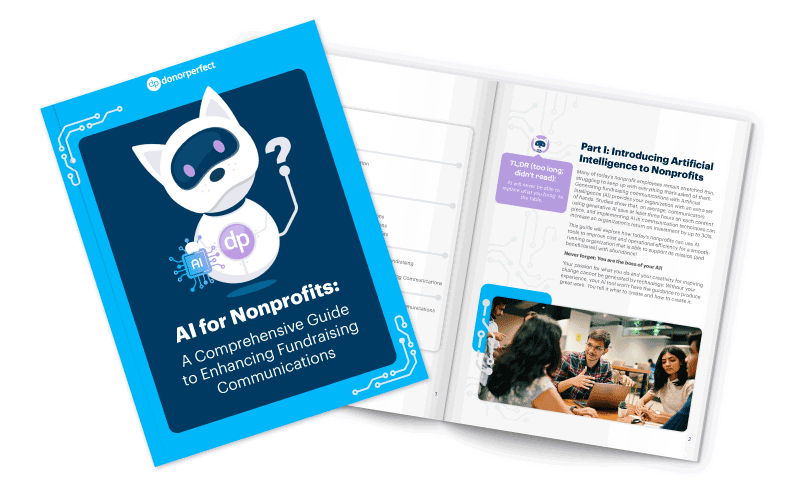
Download AI for Nonprofits: A Fundraising Communications Guide and learn practical ways to create, personalize, and refine your nonprofit outreach with AI—while protecting donor trust and keeping your organization’s voice intact.
Turn donor data into timely action
Segmentation isn’t only about reaching your supporters with the right message, but about taking the right step when it counts the most. Timing is everything, and your fundraising software’s built-in automation features can help your team stay on top of important tasks and become aware of important changes as soon as they happen.
5) Automate consistent relationship-building tasks
Some communications should happen at predictable points in the donor relationship. Manually finding and contacting every donor in a given segment, however, can take up time your staff could spend on higher-touch conversations.
For any kind of donor, saying thank you is the first step after a gift is made. Automated receipts and acknowledgments can help you ensure donors receive timely confirmation of and gratitude for their donation—but those emails should always be accompanied by a more personal touchpoint.
Additional automation tools can help your team assign future or recurring tasks to staff members so important relationship-building activities remain part of the fundraising calendar. For example, DonorPerfect Scheduled Outreach supports task scheduling and contact management so teams can plan personalized follow-up and maintain donor relationships more consistently.
Your nonprofit might use scheduled tasks to:
- Assign quarterly check-ins with major donors
- Remind staff to contact recurring donors before an anniversary
- Schedule cultivation or stewardship touchpoints after an event
- Plan periodic outreach to lapsed or at-risk donors
- Update program supporters on the impact of their gift
- Invite recent first-time donors to an upcoming event
This type of automation is especially useful for establishing consistent moves management workflows or donor journeys for a given segment. For instance, for new donors, you might send a welcome email two days after their first gift; make a personal thank-you call 30 days after the gift; and share an event invitation or other participation opportunity after two months.
Consistency is key. Planned donor outreach is less likely to disappear during busy appeals, events, or year-end fundraising.
BOTTOM LINE: Automating routine outreach can help your team turn important donor segments into a consistent schedule of cultivation and stewardship.
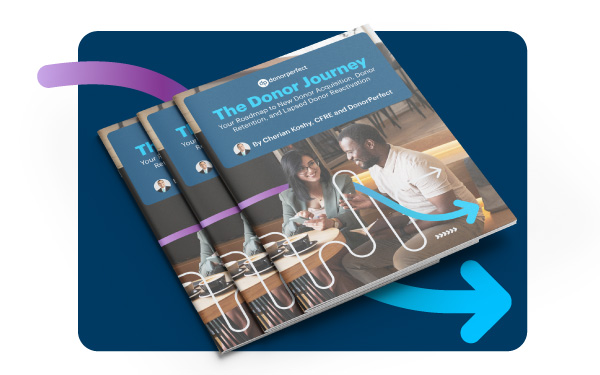
Cherian Koshy’s free guide demonstrates how to map pathways that guide key donor segments toward deeper generosity and long-term engagement.
6) Trigger staff action when donor activity changes
Not every donor should enter an automated email sequence, and not every donor action can be planned in advance. Sometimes, a change in donor behavior may qualify them for a new donor segment entirely. A supporter may make an unusually large gift, increase their giving, return after a period of inactivity, or reach a milestone that deserves personal attention.
Smart automation tools, such as DonorPerfect’s SmartActions, allow your team to create if-then rules within your fundraising CRM to trigger specific reminders or prompts when a donor takes action. This not only facilitates more proactive follow-up, but enables you to remain agile as donors move in and out of specific segments.
Your nonprofit could use action-based fundraising automation to:
- Assign a thank-you call after a significant gift
- Prompt outreach when a donor reaches a giving threshold
- Flag an increase or decline in giving
- Create a follow-up task for a VIP event attendee
- Alert staff members when a recurring gift changes
- Prompt review when a lapsed donor gives again
- Surface activity from a major giving prospect
For any automated action, be clear about who owns the task, what action should be taken, and when it should happen. The goal is to build dynamic follow-up into your team’s workflow so that opportunities don’t depend entirely on someone remembering to run a report or check a list.
BOTTOM LINE: Smart automation helps your team respond when new donor activity changes who belongs in a segment or what that segment needs next.
Practice donor conversations before they happen with fundraising AI
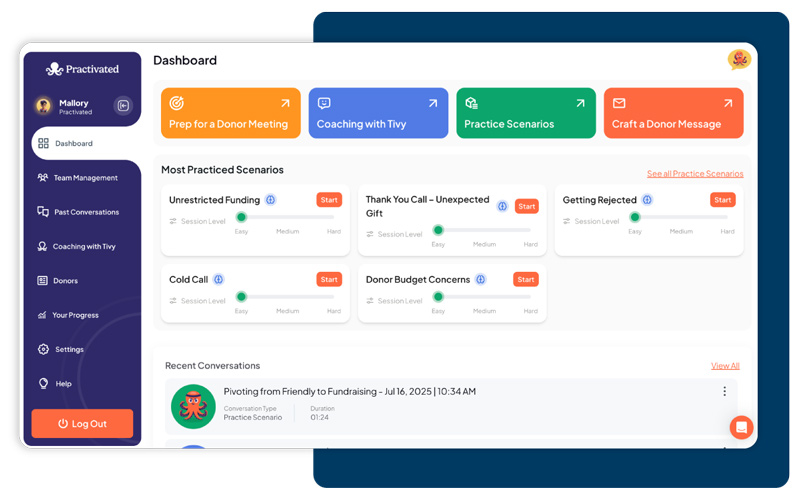
Developed by nonprofit expert Mallory Erickson, Practivated is an AI-powered conversation platform made specifically for fundraisers. Through realistic simulations, and instant feedback, it can help your team prepare for donor asks, navigate objections, and approach important donor conversations with greater confidence.
Choose a fundraising CRM that turns segmentation into action
Smarter donor segmentation goes beyond producing more lists. It involves building a connected process that helps your team understand donors, tailor communications, and act at the right time.
A modern fundraising CRM should help your nonprofit:
- Enrich donor records
- Prioritize fundraising opportunities
- Keep donor segments current
- Create relevant messaging
- Prompt staff follow-up
- Schedule timely outreach
- Measure fundraising growth
DonorPerfect brings data insights, reporting, communications, and fundraising automation together in one fundraising CRM. These connected tools help nonprofit teams spend less time rebuilding lists and coordinating repetitive work and more time nurturing relationships.
AI and fundraising automation are important parts of a modern CRM, but they are only part of the decision. Your nonprofit also needs to consider usability, integrations, implementation, support, scalability, and long-term flexibility. The right donor management system should fit the way your team works today while helping you make better use of your data as your fundraising strategy evolves.
Download our free guide to buying fundraising software, How to Choose the Best Nonprofit CRM: Your 10-Step Checklist, to evaluate your needs and make an informed decision.
Frequently Asked Questions
1. How can fundraising AI improve donor segmentation?
2. What are AI fundraising tools used for?
3. How does fundraising automation support donor segmentation?
4. How can a fundraising CRM keep donor segments current?
5. Can AI fundraising personalize donor communications?
6. What should nonprofits look for in a donor management system?
Download How to Choose the Best Nonprofit CRM

Related resources

You Can Do It: Scaling Up in Tough Times
The question is: what does it take to grow in the current moment? Joan Garry and Glennda Testone have been ...

Donor Segmentation Tips: How to Grow a Healthier Email List
Turn supporter data into more relevant outreach and stronger donor engagement Your nonprofit email list is constantly changing. New supporters ...
Follow us on social!