






October 27, 2026 | Expert Webcast, Fundraising Operations, Nonprofit Trends, Planning, Volunteer Management
How to Scale in Tough Times: 5 Strategies for Nonprofit Planning and Sustainable Growth
Joan Garry and Glennda Testone on deeper board engagement and building a stronger nonprofit fundraising strategy
“Tough times” can take many forms for a nonprofit. A major grant may disappear, costs may rise faster than revenue, demand for programs may outpace staff capacity, or an uncertain funding environment may make even well-planned investments feel risky.
Under those conditions, it is understandable for organizations to pull back. Leaders may focus on reducing expenses, protecting reserves, limiting risk, and simply getting through the immediate challenge. But strong nonprofit planning requires looking beyond the immediate pressure to consider what the organization is ultimately trying to protect, strengthen, or build.
In DonorPerfect’s recent webinar, You Can Do It: Scaling Up in Tough Times, nonprofit leadership experts Joan Garry and Glennda Testone of the Nonprofit Leadership Lab encouraged nonprofit leaders to consider another possibility: difficult circumstances do not always have to lead to smaller ambitions.
Their message was not about ignoring financial realities or pursuing growth for its own sake. Instead, they focused on the importance of defining the impact an organization wants to create, then building the funding, infrastructure, leadership, and internal support needed to move toward it.
Here are five lessons from their conversation for nonprofit leaders and fundraisers thinking about how strategic planning for nonprofits can support sustainable growth, even in an uncertain environment.
1. Plan for impact, not budget size
When nonprofit leaders talk about scaling, the conversation often turns quickly to budget growth, staffing, or fundraising goals. Those measures can all be important, but Joan and Glennda encouraged attendees to begin somewhere else: impact.
During the webinar, they defined scale as expanding the reach, depth, or duration of work that is already effective. Depending on the organization, that might mean serving more people, entering a new community, strengthening an existing program, increasing organizational capacity, or extending the influence of a successful approach. The “common denominator” is not simply getting bigger, but increasing the impact the organization is able to create.
That distinction matters, because it is easy for financial goals to become disconnected from the purpose they are meant to serve. A larger budget may be necessary to support growth, but the budget itself is not the end goal.
Joan illustrated this with the example of The Art Therapy Project. The organization’s board initially wanted to explore how it could grow from a $1 million budget to $5 million. Rather than beginning with the number, Joan encouraged the Executive Director to get the board talking about what that additional funding could actually make possible.
What would a 5X budget make possible? If a transformative gift came our way, what would we do with it and why?
– Joan Garry, Founder, Nonprofit Leadership Lab
That reframing led the board into a broader conversation about impact and opportunity. Instead of treating growth as an abstract financial goal, they began to imagine what greater resources could allow the organization to accomplish.
Define what success looks like
This is where strong strategic planning for nonprofits can become especially valuable. Before setting a major growth goal, it can be useful to ask what success would actually look like.
Ask yourself:
- Who could you serve that you cannot currently reach?
- Which successful program could you strengthen or expand?
- What challenge could your organization address more effectively?
- What would you change if capacity were no longer the limiting factor?
- What resources would be required to make that impact possible?
These questions can give fundraising goals a clearer purpose. They also help donors understand what their support is intended to accomplish, rather than asking them to invest in growth for growth’s sake.
Build a stronger foundation for sustainable fundraising
Once you know the impact you want to create, the next step is building a fundraising strategy that can support it over time. Our free guide, How to Build a More Sustainable Fundraising Strategy, shares practical ways to strengthen donor engagement, retention, and fundraising ROI while protecting long-term nonprofit revenue.

2. Build your fundraising strategy around a shared vision
When an organization is under financial pressure, fundraising can quickly become centered on immediate need: closing a budget gap, replacing a lost grant, covering payroll, or simply making it through the next few months.
Those needs may be urgent, and Joan and Glennda did not suggest minimizing them. Instead, they cautioned against allowing the immediate crisis to become the full story.
A donor may understand why an organization needs help getting through a difficult period. What can make the appeal more compelling is understanding what that support will preserve or make possible in the longer term.
The key to fundraising in tough times, whether you are struggling or whether you have some momentum, is vision.
– Joan Garry, Founder, Nonprofit Leadership Lab
For fundraisers, that means connecting the present challenge to a meaningful destination. Instead of asking supporters only to help the organization recover, show them what becomes possible if they do.
A strong nonprofit fundraising strategy can make that connection explicit by linking near-term fundraising goals to long-term mission impact. Donors are not simply being asked to solve a financial problem; they are being invited to help move the organization toward something meaningful.
That same principle can be especially useful with boards, which may become more risk-averse during periods of uncertainty.
Use board engagement to elevate the conversation
During the webinar, several attendees asked how to move board members away from a scarcity mindset and toward a more ambitious view of the future.
Joan and Glennda’s advice was to create space for broader, more generative conversations. Boards still need to understand financial realities and exercise appropriate oversight, but focusing exclusively on expense reductions and budget variances can make it difficult to imagine what the organization is trying to build.
Instead, stronger board engagement can begin with questions such as:
- What impact do we want this organization to be known for five years from now?
- What unmet need are we especially well positioned to address?
- Where do we see the greatest opportunity to deepen or expand our work?
- What could significantly greater resources allow us to accomplish?
- Which investments would move us closer to that future?
Joan and Glennda noted that board members are often more energized when they are invited to imagine what is possible and understand how their role contributes to getting there.
That kind of board engagement can also make later fundraising discussions more productive. When board members understand the destination, they have a clearer reason to advocate for it, invest in it, and help bring others along.
Help donors see what their gifts can make possible
With Givecloud impact giving options, nonprofits can connect specific giving opportunities with tangible outcomes, helping supporters understand how an immediate contribution advances a larger vision. Impact-focused forms can make the connection between today’s ask and tomorrow’s results clearer at the moment a donor chooses to give.

3. Approach growth as organizational change
Greater funding and increased demand can create exciting opportunities for a nonprofit, but they can also create new pressures internally.
A major grant may require additional staff. A successful program may need stronger reporting systems or new technology. Serving more people may change workflows, fundraising communications, or leadership responsibilities. Even positive growth can become difficult to sustain if an organization’s internal capacity does not grow with it.
Glennda saw this firsthand during her 14 years leading New York City’s LGBT Community Center (“The Center”). When she arrived in 2009, the organization was approximately $1 million in debt, had a maxed-out line of credit, and was managing aging payables while recovering from the 2008 economic downturn. By the time she left in 2023, the organization’s annual budget had grown from roughly $6 million to $16 million, alongside a $9 million building renovation and major programmatic growth.
The story sounds straightforward when reduced to those milestones, but Glennda emphasized that the actual path was much more complicated. There were layoffs, periods of stabilization, opportunities the organization had to decline, and moments when it had to reconsider what it could realistically sustain.
For her, one of the most important lessons was that scaling is not simply a fundraising challenge. It is an exercise in change management, and effective nonprofit planning needs to account for that internal change as much as the external opportunity.
Make sure your nonprofit planning includes internal capacity
Before taking on a new program, major gift, or other growth opportunity, it is worth considering what the change will require beyond the initial funding.
Questions might include:
- Does our staff have the capacity to take this on?
- Will we need new positions or expertise?
- Are our systems and processes ready for greater volume?
- Do we have the right policies and infrastructure in place?
- Can we sustainably fund this work after the initial investment ends?
- How will we communicate the change to staff, board members, donors, and other stakeholders?
Glennda shared one example from her own leadership experience. Her organization received $120,000 to launch a new program, hired the necessary staff, and moved forward enthusiastically. When the funding was not renewed the following year, however, the organization had to spend the next several years finding ways to sustain the program.
The takeaway is not necessarily to avoid ambitious opportunities, but to think beyond the first year and consider what success will require once the initial funding, enthusiasm, or urgency has passed.
Pause and ask yourself, How will this impact my staff? My team? How will this impact our resources? Our infrastructure? Do we have the kind of policies and programs in place that we need to be able to do this?
– Glennda Testone, CEO, Nonprofit Leadership Lab
Bring your people along as you grow
Sustainable change also depends on communication.
New strategies can affect staff roles, organizational culture, board expectations, and even the way longtime supporters understand the mission. Joan cautioned that leaders who are eager to make changes can sometimes imply, intentionally or not, that the organization’s previous approach was wrong. Instead, she encouraged leaders to honor the people and decisions that helped bring the organization to its current position while explaining why the next stage requires something different.
That process requires consistent communication throughout the organization and should be considered part of both strategic planning for nonprofits and ongoing change management.
When people understand what is changing, why it matters, and how it connects to a shared vision, they are more likely to see themselves as participants in the change rather than simply recipients of it.
Keep building stronger nonprofit leadership
Growth and change require people to move forward together. Explore Rethinking Nonprofit Board Engagement: Moving Beyond the Ask for more ideas on building productive relationships with the board members who help guide and champion your mission.

4. Make room for a nonlinear path
Growth stories often sound much cleaner in hindsight than they feel in the moment. A nonprofit may eventually be able to point to increased revenue, successful campaigns, expanded programming, or a larger team, but the path between those milestones is rarely a straight line.
Glennda illustrated this by sharing the progression of the LGBT Community Center over her tenure. The organization moved from financial instability to stabilization and growth, then encountered new periods that required reassessment and contraction before it could grow again.
The COVID-19 pandemic offered one clear example. During that period, increased funding and more flexible unrestricted support allowed the organization to expand. Several years later, as that temporary funding environment changed, leaders realized that some of that growth could not be sustained at the same level. The organization needed to shrink, stabilize, and position itself for future growth.
That kind of adjustment does not necessarily indicate that the larger vision failed. In some cases, it is exactly what allows the organization to continue pursuing it over the long term.
This is another reason nonprofit planning should leave room for revision. A period of stabilization can give an organization time to strengthen infrastructure. Declining an opportunity can preserve resources for work that is more closely aligned with the mission. A smaller pilot can help leaders understand whether a larger investment is justified.
The important question for an organization to ask is whether its decisions are moving it toward the impact it ultimately wants to create.
Test ambitious ideas before scaling them
During the webinar Q&A, Joan and Glennda recommended pilot programs as one practical way to build support for an ambitious idea. If a board, donor, or staff team is not yet ready to commit substantial resources to a new approach, a smaller test can provide useful evidence.
A pilot might help an organization:
- Demonstrate whether the idea is effective
- Collect results and participant feedback
- Identify staffing or operational challenges
- Give board members tangible evidence of potential
- Strengthen the case for future funding
That proof of concept can be especially valuable when an organization’s long-term vision cannot be achieved immediately. Joan suggested breaking a larger goal into manageable stages and helping supporters understand what progress will look like along the way.
For fundraisers, pilots can also strengthen a nonprofit fundraising strategy by connecting future investment with real evidence. Instead of asking donors to support an entirely theoretical possibility, you can demonstrate what has already worked and explain what additional resources could make possible at a greater scale.
Measure what works before you scale it
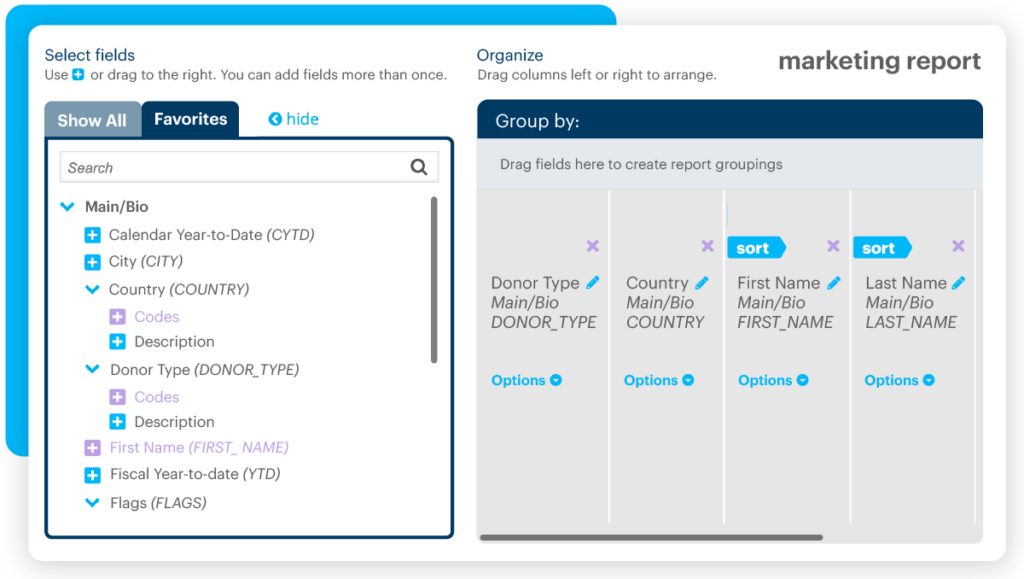
A pilot can help you test a promising idea, but the results should guide what happens next. DonorPerfect reports and dashboards make it easier to establish benchmarks, monitor fundraising KPIs, compare campaign results, and visualize trends so your team can see what is working before committing to a larger investment.
5. Strengthen your nonprofit fundraising strategy through funding diversification
One of the clearest risks of relying heavily on a single funding source is that a change outside your organization’s control can quickly become an organizational crisis.
During the webinar Q&A, Joan and Glennda discussed an organization that received approximately 70% of its funding from government sources before that support was abruptly lost. The immediate consequences were significant, and the organization had to make difficult decisions about what it could continue supporting.
At the same time, the loss forced its leaders to reconsider the organization’s long-term funding model. Rather than simply replacing one government source with another, they began exploring foundation support and other revenue opportunities that could make the organization less vulnerable to a similar disruption in the future.
Funding diversification cannot eliminate uncertainty, but it can reduce the likelihood that one change will determine an organization’s future. For that reason, it is worth considering as part of both strategic planning for nonprofits and an organization’s broader fundraising strategy.
Depending on your mission and fundraising model, a more diversified approach might include:
- Individual giving
- Major gifts
- Monthly giving
- Foundation support
- Corporate partnerships
- Events or peer-to-peer fundraising
- Planned giving
- Government funding
The right mix will vary from one nonprofit to another. What matters is understanding where your support currently comes from, where there may be too much dependence on one source, and which relationships or channels are worth developing over time.
Diversification also requires patience. A nonprofit that has historically relied on grants, for example, will not build a mature major giving or monthly giving program overnight. But making that work part of your nonprofit fundraising strategy before a crisis occurs can create greater flexibility when conditions change.
Find more potential within your existing donor base
Diversifying your fundraising does not always mean finding an entirely new audience. DonorPerfect with DonorSearch wealth insights can add wealth and demographic information to the donor data you already have, helping your team identify supporters with greater giving potential and prioritize stronger major-gift opportunities.
Paired with giving history and engagement data in DonorPerfect, those insights can help fundraisers decide where deeper cultivation may have the greatest potential.

Bring nonprofit planning, board engagement, and fundraising together
Throughout the webinar, Joan and Glennda returned to the idea of a “North Star”: the few important outcomes an organization ultimately wants to achieve.
That perspective becomes especially important when circumstances are difficult. Funding changes, costs increase, programs face new demands, and staff capacity has limits. A long-term vision does not make those realities disappear, but it can help leaders decide how to respond to them.
Strong nonprofit planning helps an organization determine when to grow, when to stabilize, which opportunities to pursue, and where additional investment is needed. Effective board engagement helps build support around those decisions, while a clear nonprofit fundraising strategy connects the vision to the resources required to move it forward.
That work is easier when your team has the right information at hand. With DonorPerfect, nonprofits can use connected donor data, reporting, and fundraising tools to better understand where support is coming from, identify opportunities for growth, and track progress over time.
Keep building a stronger, more sustainable fundraising strategy
Whether your organization is navigating uncertainty, preparing for growth, or strengthening the foundation for what comes next, sustainable progress starts with a clear plan.
Download our free guide to building a more sustainable fundraising strategy for practical ways to strengthen donor engagement, retention, and fundraising resilience.
Download your copy of How to Build a More Sustainable Fundraising Strategy

Related resources

Protect the Spark: Creating digital giving experiences that delight donors from the first gift


Follow us on social!