




Subscribe to our mailing list
February 16, 2026 | Donor Engagement, Fundraising Communication, Fundraising Operations, Online Fundraising, Planning
Nonprofit Social Media Templates
With helpful tips and free tools to develop a sustainable feed
Social media can feel like one more plate spinning in an already full nonprofit workload. Your donor community needs consistent updates to stay engaged, even if your communications rely on one staff member doing the work of three, or part-timers jumping in when they can.
No matter your current situation, social media is worth prioritizing because:
- It remains one of the most affordable ways to stay visible and build trust.
- You don’t need a dedicated content team or a professional designer. Even simple graphics paired with authentic storytelling can go a long way. And free tools like Canva make it easy to build consistent branding over time.
With a few strong content themes and ready-to-use templates, your team can inspire generosity by posting regularly.
The goal of nonprofit social media
The best-performing nonprofit social media content does three things:
- Builds trust through transparency – Donors want to see where their gifts go, what they will accomplish, and what progress looks like in real time.
- Shares stories, not just announcements – Impact stories consistently outperform generic promotions because they help people feel emotionally invested.
- Creates ongoing engagement – Your nonprofit’s social media presence should do more than inform. It should engage donors in relationship-building activities.
A healthy nonprofit social media feed might include:
- Impact stories
- Program updates
- Donor appreciation
- Volunteer highlights
- Fundraising appeals
- Community moments
- Advocacy and education
- Event promotion and follow-up
The secret to consistent posting
One of the biggest mistakes nonprofits make is thinking they need to reinvent the wheel every time they post. Instead, the most sustainable approach is to rotate through a few core post types. The format stays the same; only the content changes. This saves time, reduces burnout, and ensures your social feed stays balanced.
Examples of repeatable content themes for nonprofit social media:
- Beneficiary spotlights
- Behind-the-scenes program updates
- Donor thank-you shoutouts
- Monthly impact milestones
To make this easier, we’ve put together some examples you can customize! Below are several nonprofit social media templates you can start using right away.
Nonprofit social media templates
1. Announce an event, campaign, or big moment
Your post should stop the scroll and make supporters feel like something meaningful is coming.
Template: You’re invited! Join us for [EVENT/CAMPAIGN NAME] on [DATE] at [LOCATION or ONLINE]. Together, we’ll [PURPOSE OF EVENT] to support our mission of [MISSION]. Learn more or register here: [LINK]
Pro tip: Consider strengthening your announcement with a relatable story or quote to align it with your donors’ reasons for giving.
Example: Last year, we raised [AMOUNT] in support of [BENEFICIARY], making it possible for them to [OUTCOME]. This year, we’re hoping to [GOAL], and your donation can make all the difference. Just ask [BENEFICIARY]: “[Insert quote from beneficiary showing gratitude.]”

2. Encourage supporters to bring someone with them
Fighting for causes can feel lonely, especially if you’re donating or volunteering alone. A sense of community can unite people around a common goal, so one of the easiest ways to grow your constituency is by encouraging individual supporters to share your work within their own circles.
Template: You are not alone in the fight for [MISSION]. Everything we do is stronger with community. Invite a friend, partner, or coworker to join you for [EVENT/VOLUNTEER DAY/CAMPAIGN] to help spread our mission even further. Details here: [LINK]
Pro tip: Consider adding an element of urgency with a giving challenge or goal update, reminding them that strength in numbers can move the needle forward.
Example: We’re [AMOUNT] away from [GOAL], and we need your help to deliver [OUTCOME] to [BENEFICIARY]. Do you have any friends, family, or coworkers who are passionate about [MISSION]? We have [# DAYS/HOURS] left to make it happen—please consider passing this post along!
3. Share an impact story that makes the mission real
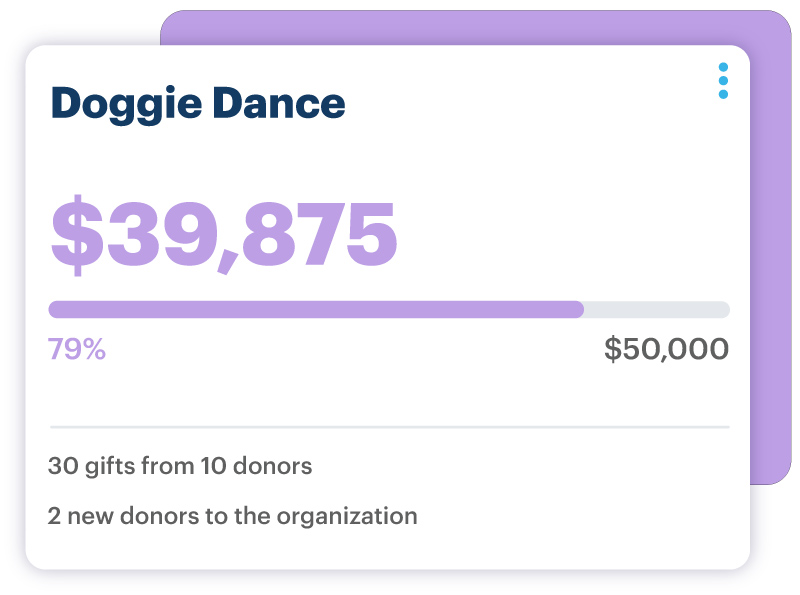
Many donors are more concerned with contributing to a certain outcome than they are with contributing to your organization as a whole. That’s why impact storytelling remains one of the most effective nonprofit social media strategies, especially when connected to a specific campaign, event, or program.
Template: Meet [NAME]. Because of supporters like you, [SHORT STORY OF CHANGE]. Your generosity helped provide [SERVICE/RESOURCE], and today, [RESULT OR FUTURE IMPACT]. This is what your support makes possible: [LINK]
Pro tip: Consider including a photo or video to illustrate your story—using a free tool like Canva, you can create visuals in seconds!
Example: We started [PROGRAM] to help [BENEFICIARY] with [OUTCOME]. Because of the hard work of our donors, advocates, and volunteers, [NAMED BENEFICIARY] is now able to [SPECIFIC OUTCOME OR QUOTE]. Watch this short video to learn more about [PROGRAM].
4. Post a quick program update
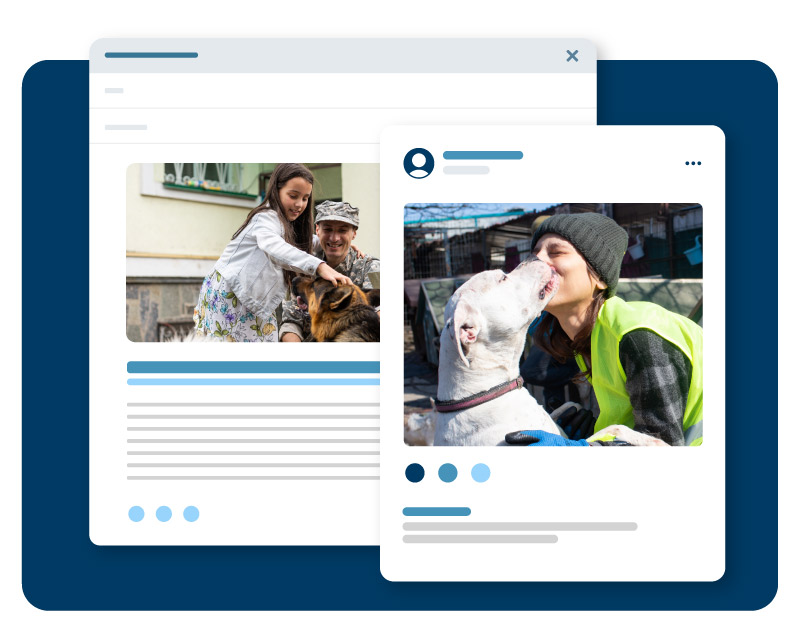
Supporters want to know what’s happening behind the scenes. Beyond visibility, regular program updates also help with transparency and trust—they let people know that you are actively working on delivering the change they want to see.
Template: Here’s what’s happening this week at [ORG NAME]:
– [PROGRAM UPDATE]
– [MILESTONE OR WIN]
– [COMMUNITY IMPACT STAT]
Thank you for being part of this work.
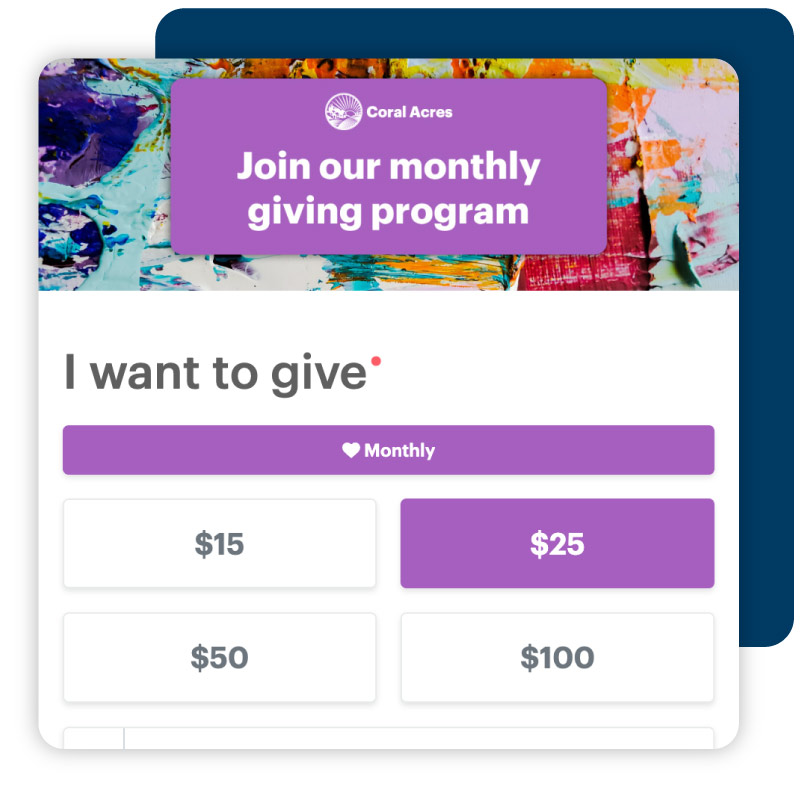
Pro tip: Consider linking to your recurring giving resources to drive retention.
Example: For just a few dollars a month, you can help sustain our impact. For example, [RECURRING AMOUNT] per month provides [IMPACT DESCRIPTION]. Learn more: [LINK]
5. Write a donation appeal that feels personal
Nonprofit social media posts work best when they are specific, human, and impact-driven. Adding a time-sensitive aspect to your ask can also improve donor engagement results.
Template: Right now, [NEED OR URGENCY]. A gift of $[AMOUNT] can provide [TANGIBLE IMPACT] for [POPULATION SERVED]. Will you help today? Donate here: [LINK]
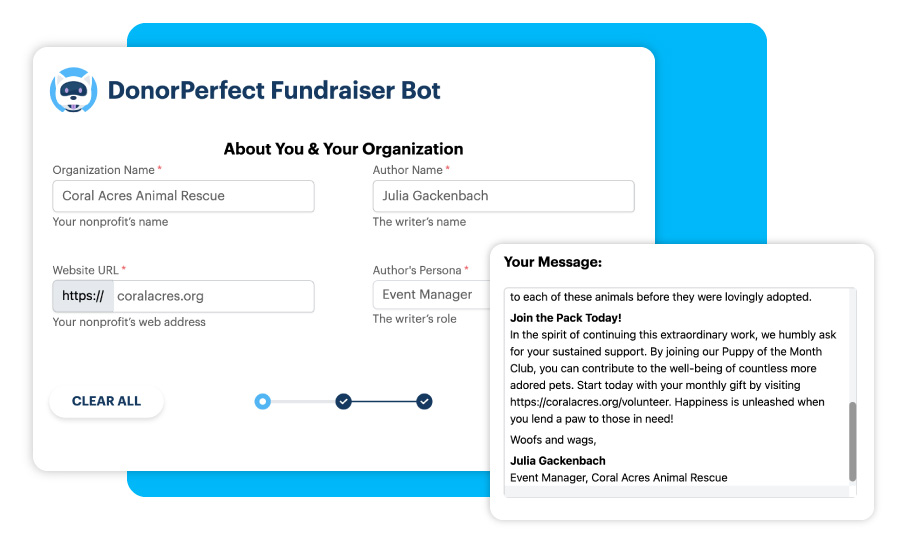
Pro tip: It can be difficult to make a template feel personal to your donors. Consider using a free tool like the DonorPerfect Fundraiser Bot to help you tailor your appeal to specific groups or campaigns, or even adapt your appeal for different communication channels.
6. Spotlight a donor, volunteer, or partner
Recognition is stewardship, and stewardship drives retention. As long as you have permission from the person(s) you’re highlighting, you can spotlight individual donors, program participants, volunteers, giving circles, event attendees, and more. This adds a layer of “social proof” to your posts, inspiring others to follow their lead.
Template: Shoutout to [NAME or GROUP]. Because of their support, we’ve been able to [IMPACT RESULT]. We’re so grateful for the people who make this work possible. Want to get involved? [LINK]
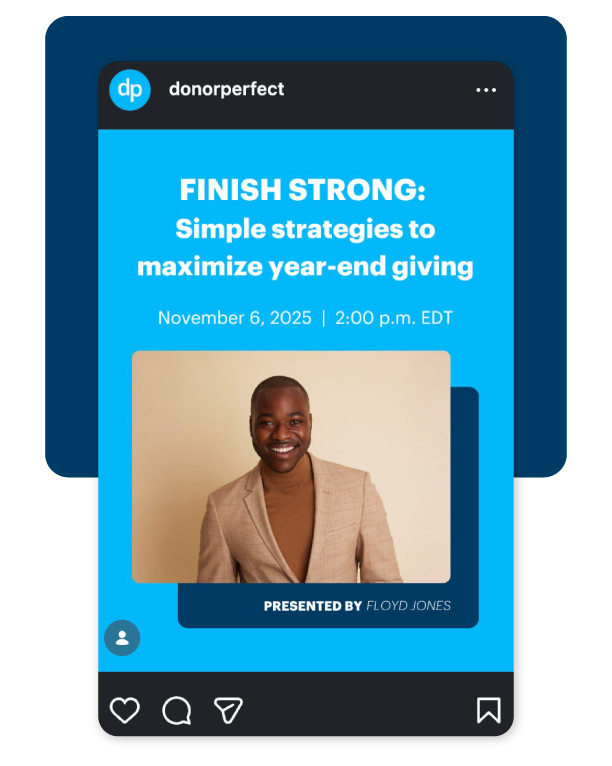
Pro tip: Don’t forget about speakers, experts, and special guests. If you have exclusive or educational opportunities coming up, you can drum up excitement and drive registrations on your social feed.
Example: We’re excited to feature [NAME], who will be joining us for [EVENT/PROGRAM]! They’ll be sharing insights on [TOPIC] and helping advance our mission of [MISSION]. Save the date: [LINK]
7. Connect with your local community
People take pride in making their community a better place, and nonprofits thrive when they deepen local roots. There may be donors, volunteers, and partners nearby who are passionate about your mission, but unaware of opportunities to participate.
Template: Calling our neighbors in [CITY/REGION]! We’re proud to serve this community through [PROGRAM OR CAUSE], and we’d love for you to be part of it. Get involved here: [LINK]
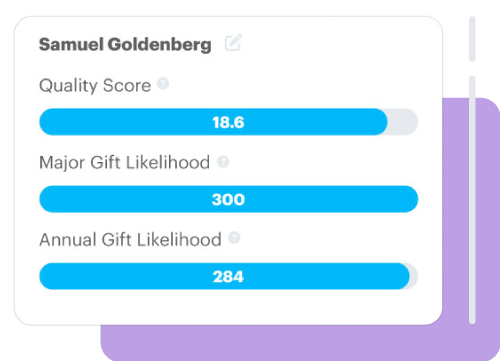
Pro tip: See if your nonprofit CRM integrates with a prospect research tool like DonorSearch to identify, analyze, and segment donors by location and target specific regions (e.g., within a 50-mile radius). This kind of integrated solution enables filtering donors by zip code, mapping, and leveraging data on real estate holdings and past charitable gifts to refine your fundraising strategy.
8. Post a thank-you or results recap
Don’t stop posting once your campaign is over or your goal is reached—use follow-up to build loyalty. Any time you reach a fundraising goal, especially one that you’ve rallied your community around, take time to share your results and keep the momentum going.
Template: Thank you, [COMMUNITY]! Because of your generosity, we raised [$XX,XXX] and will be able to [SPECIFIC IMPACT]. We’re so grateful to have you with us. Stay connected: [LINK]
Pro tip: Can’t fit it all in a short social media post? Free tools like ChatGPT and the DonorPerfect Fundraiser Bot can help you develop an in-depth report to share with not only your supporters, but also leadership, board members, and stakeholders.
Learn more about AI for noprofits—download our free guide >>
Weekly posting rhythm for nonprofit social media
If your organization has limited time and staff, remember that consistency beats volume. It’s more important to publish regular updates that your followers can rely on than to fill their feeds with generic solicitations.
A sustainable weekly schedule might look like:
- Monday: Program update
- Wednesday: Impact story
- Friday: Fundraising appeal or donor spotlight
- Weekend: Event or community content
A mix like this can keep your feed donor-centered, mission-focused, and engaging without overwhelming your team. Remember, social media is simply an affordable way to stay visible to people who care and give them reasons to keep showing up. And with tips and templates like these, you don’t have to start from scratch every time you post.
Looking for more ways to stay visible and attract new supporters? We created Your Guided Growth Plan with nonprofit marketing expert and podcast host Dana Snyder to help you develop a modern donor acquisition strategy that matches your budget.
For social media templates catered to event planning, download our free guide below.
Download 10 Social Media Templates for Nonprofit Event Planners

Related resources

DAFpay
With DAFpay, donors can recommend a grant from their DAF as part of your online giving experience. That makes it ...

Donor Segmentation Tips: How to Grow a Healthier Email List
Turn supporter data into more relevant outreach and stronger donor engagement Your nonprofit email list is constantly changing. New supporters ...
Follow us on social!